12 December 2025
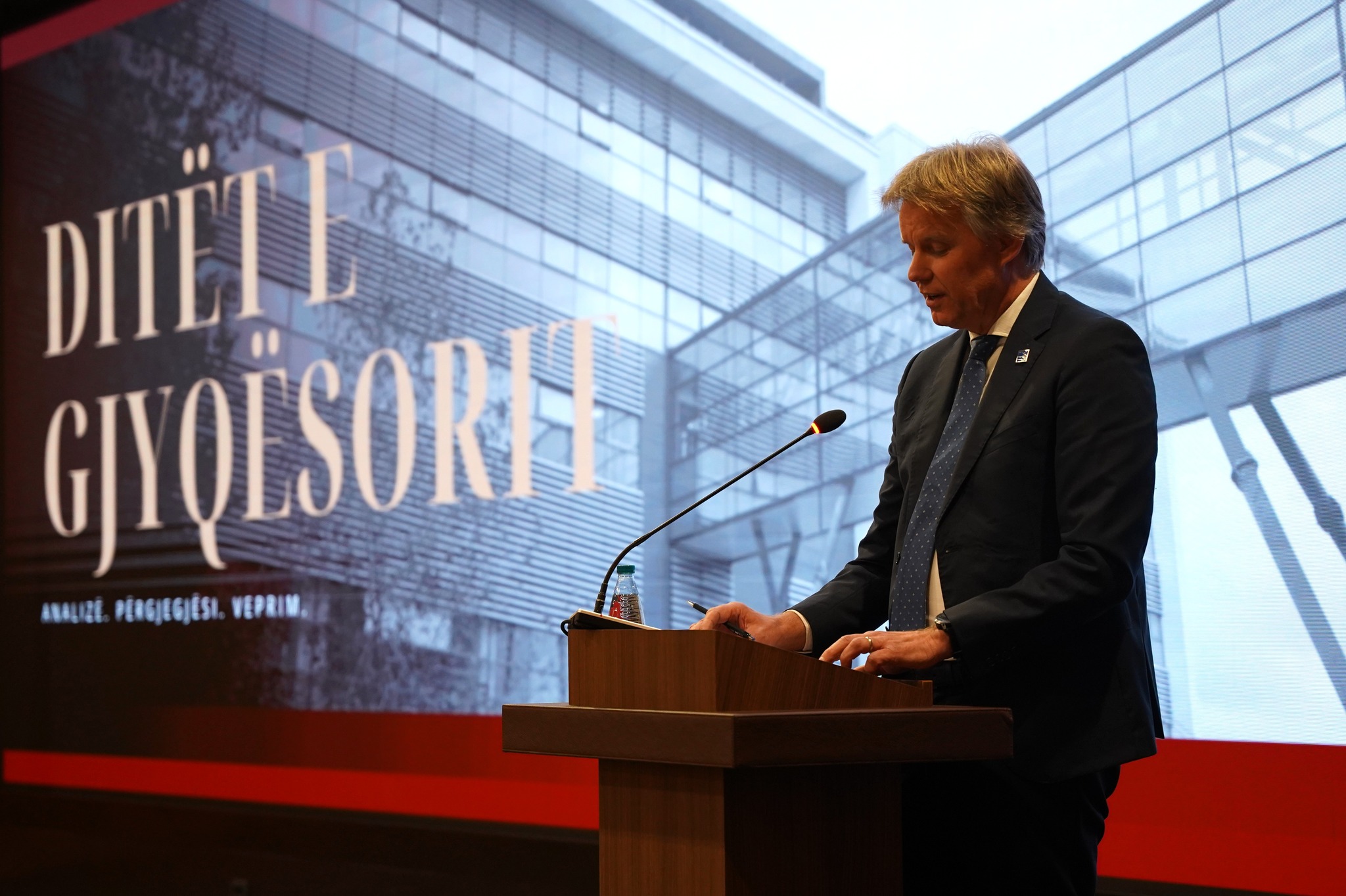
On 5 and 12 December 2025, the Kosovo Judicial Council (KJC) organized the Days of Justice 2025 Conference. The two-day conference is held annually, bringing together justice institutions, international partners and civil society to promote the rule of law, human rights and access to justice in Kosovo.
In line with past editions, this year the KJC invited the European Union Rule of Law Mission in Kosovo (EULEX) to actively contribute to the conference.
The Chief of EULEX Case Monitoring Unit, Hubert van Eck Koster, represented the Mission by sharing notes on EULEX’s robust judicial monitoring and justice monitoring reporting activities, emphasizing that the cooperation between EULEX and the KJC is built on transparency, access, and trust - as key elements that reinforce judicial independence, support reforms and enhance public confidence.
On 5 December, van Eck Koster attended the opening session of the programme joining the panel discussion “Cooperation of the Judiciary with International partners - Support and Monitoring”.
His contribution focused on the process implementation of recommendations to strengthen the functioning of judiciary and presented the findings and recommendations of the recently published 2025 EULEX Justice Monitoring Report, noting that it offers concrete, evidence-based guidance. He stressed that “EULEX does not see monitoring and cooperation as parallel processes, but as mutually reinforcing,” adding that the KJC’s openness already places it among the most transparent judicial governance bodies in Kosovo. “The challenge ahead”, he stressed, “is to turn this openness into structured, measurable and sustainable implementation of recommendations.”
On 12 December, the Chief of EULEX Case Monitoring Unit delivered a speech in which he reflected on the transparency and genuine willingness to engage with independent external monitoring demonstrated by the KJC.
Van Eck Koster pointed out that, thanks to the mature and trust-based EULEX-KJC partnership, EULEX monitors were granted access to more than 300 hearings this year, including - where legally permissible- closed hearings. This unhindered access enabled the Mission to regularly publish its Justice Monitoring Report, based entirely on first-hand observations, structured analysis and verified data, while presenting recommendations that are concrete, achievable and in line with human rights standards. Elaborating on the complexity of their practical implementation, he underlined three elements that are decisive:
Firstly, institutional ownership. Sustainable reforms are those fully owned by the judiciary itself. When the KJC integrates recommendations into its strategic planning, internal regulations and performance monitoring, they stop being “EULEX, OSCE or Council of Europe recommendations” and become Kosovo judicial reform priorities.
Monitoring organisations also share a responsibility: through increased coordination, and aligning recommendations where possible, the KJC would have a clearer pathway to adopt them.
Secondly, prioritisation and sequencing. Not all recommendations require the same urgency or the same tools. Distinguishing short-term procedural improvements from medium-term capacity-building and long-term structural reforms allows for realistic implementation and measurable progress.
Thirdly, continuous dialogue and follow-up. Reform is not a single act but a process. Regular technical exchanges, progress reviews and data-driven evaluation are indispensable.
“The openness of the Kosovo judiciary towards embracing further reform processes and professional debate, demonstrated through these Days of the Judiciary, is itself a sign of institutional maturity. It reflects a system that does not fear scrutiny but sees it as an opportunity for improvement,” concluded van Eck Koster.